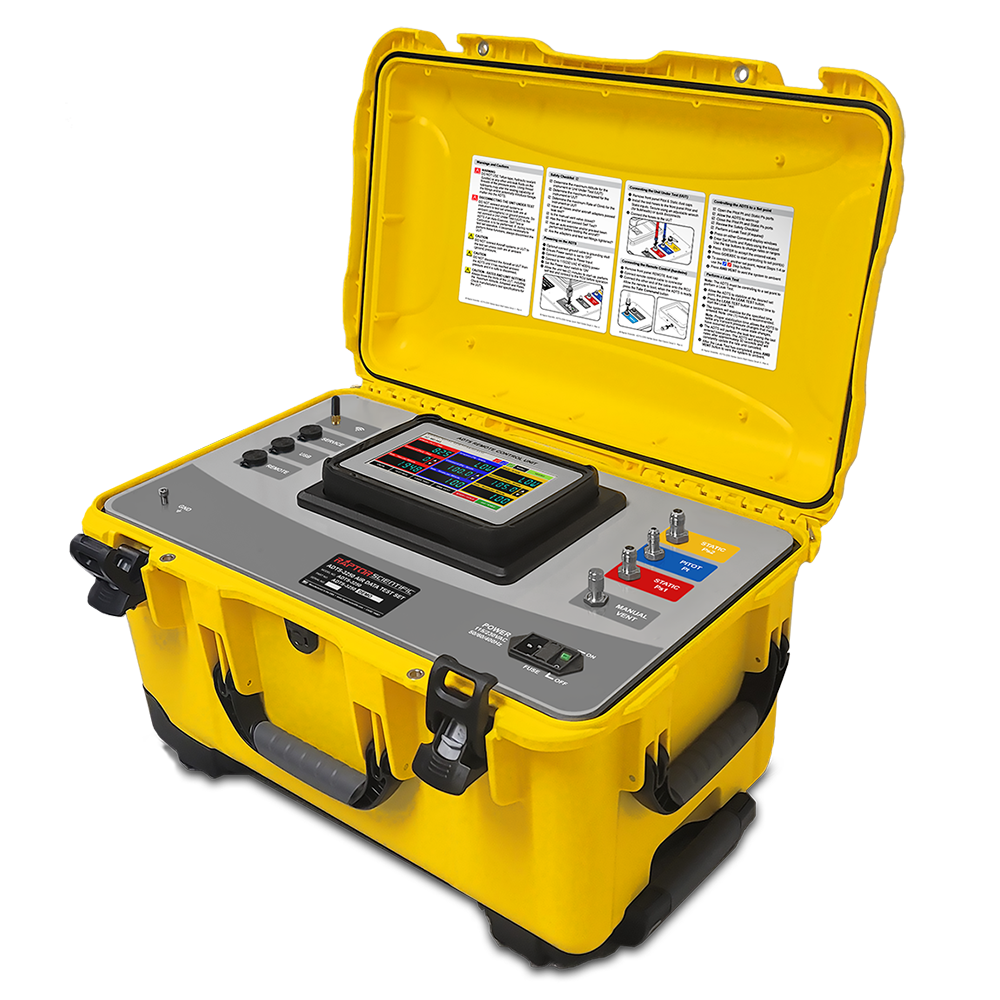
Commercial Pitot Static Testing Equipment
Pitot Static Testing on the Flightline
Years have gone by without significant advancements in the more commoditized testing functions of aircraft. Old faithful still rings true for most wrench turners grinding it out everyday to play their part in the safest aircraft regulatory environment ever. For aircraft transponder and pitot-static system tests, as required by FAR 91.411 and 91.413, these certifications cannot be performed using automation. The inspector is required to perform leak checks and accuracy verification by commanding the air data test set to each set of the required set point, then visually verify the readings on the instrumentation and readouts. But, wouldn’t it be nice to perform some of these functions at the same time, thereby saving an immense amount of time as compared to sequential testing operations with limited equipment.
The use of semi-automated pitot static test equipment offers significant advantages over manual testing methods for commercial aviation and maintenance repair organizations. Pitot static systems are critical components of aircraft, providing essential data for airspeed, altitude, and vertical speed measurements. Additionally, some newer aircraft equipped with SmartProbes can test other parameters, such as Angle of Attack (AoA). Ensuring the accuracy and reliability of these systems is paramount for flight safety and regulatory compliance. And doing them all simultaneously is a huge time-saver for the maintenance teams at MROs around the globe.
Keep reading at Aviation Maintenance Magazine.
PakarPBN
A Private Blog Network (PBN) is a collection of websites that are controlled by a single individual or organization and used primarily to build backlinks to a “money site” in order to influence its ranking in search engines such as Google. The core idea behind a PBN is based on the importance of backlinks in Google’s ranking algorithm. Since Google views backlinks as signals of authority and trust, some website owners attempt to artificially create these signals through a controlled network of sites.
In a typical PBN setup, the owner acquires expired or aged domains that already have existing authority, backlinks, and history. These domains are rebuilt with new content and hosted separately, often using different IP addresses, hosting providers, themes, and ownership details to make them appear unrelated. Within the content published on these sites, links are strategically placed that point to the main website the owner wants to rank higher. By doing this, the owner attempts to pass link equity (also known as “link juice”) from the PBN sites to the target website.
The purpose of a PBN is to give the impression that the target website is naturally earning links from multiple independent sources. If done effectively, this can temporarily improve keyword rankings, increase organic visibility, and drive more traffic from search results.

Related Posts

Mass Properties Measurement Seminar | Oct 1-3, 2024

Raptor Scientific Interns | Meet Our Talented Team